
The Cycle from Victimhood to Violence
Crow GirlThis thread examines how abused children learn the logic of coercion, how survivors can reproduce or redirect violence, and why explanation never amounts to absolution.
increasing Bearing strength in each event
 decreasing
Bearing strength in each eventdecreasingPower Learned at Home
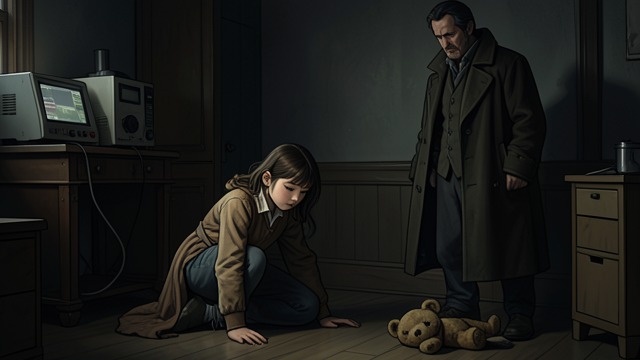
The First Lessons in Power
Violence as instruction
Victoria grows up under a father who controls her body and a mother who fails to protect her. The child’s daily calculations are about avoiding punishment, reducing danger, and learning how to satisfy a powerful adult quickly enough to shorten an ordeal.
Those lessons distort ordinary ideas of care. Touch can promise safety and signal danger at the same time; praise can reward compliance; and a parent’s affection can be inseparable from coercion. The child learns survival behaviors without being given a language for consent or responsibility.
The inherited method
The book later returns to the formula “hit, caress, protect, destroy” as a pattern learned from the adult world. It explains how a victim can internalize the perpetrator’s methods without making the resulting harm inevitable or excusable.
Victoria’s history supplies context for the violent logic that emerges, but context does not absolve her. The novel keeps both facts in view: abuse shapes later possibilities, while adults remain responsible for what they do to others.
Martin and the Turning Point
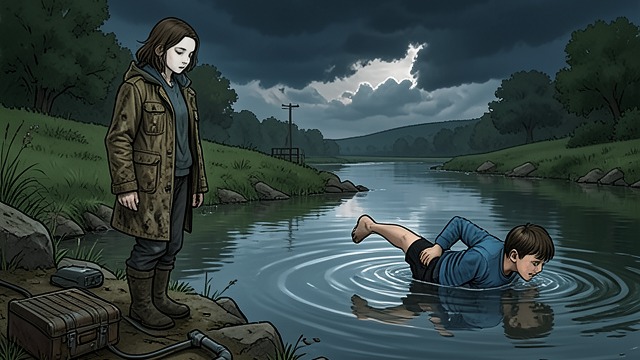
A Child’s Fear Becomes Harm
Love and possession
Victoria’s attachment to Martin brings a brief experience of trust that differs from the exploitation she knows elsewhere. She teaches him about the forest, enjoys his affection, and imagines that protecting him might redeem something of her own childhood.
But fear of losing him sharpens into possessiveness. When Martin speaks about moving to Skåne, Victoria’s panic overwhelms her ability to distinguish his independent wishes from a threat to her own emotional survival.
Violence and uncertainty
In a fractured episode by the Fyris River, she attacks Martin and puts his body in the water. Her later memories of the event are divided and incomplete, leaving her unable to hold a stable account of what she did and why.
The episode marks a devastating reversal: a child harmed by adults becomes capable of harming a younger child. The book does not make the act a simple consequence of abuse, nor does it remove the guilt. It shows how unprocessed terror can be redirected toward someone more vulnerable.
Violence Recast as a Ritual
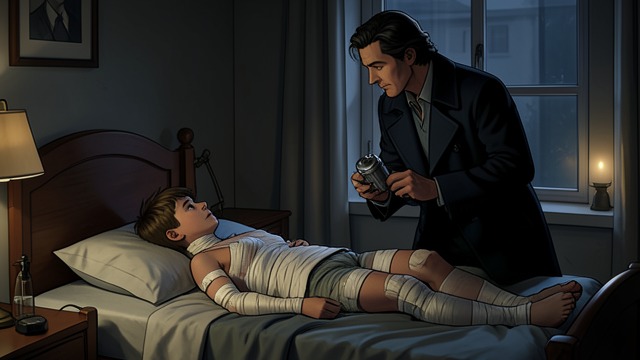
The Repetition of Harm
A system of domination
The boys found in Stockholm have been tortured, drugged, castrated, and subjected to procedures that turn their suffering into a prolonged performance. The killer’s apparent rituals convert helplessness into a source of control and meaning for the perpetrator.
The victims’ lack of official status makes their suffering easier to conceal, but it does not make the acts random or impersonal. Repeated methods suggest a world in which children are treated as material to be used, shaped, and discarded.
From explanation to accountability
The novel connects such violence to earlier abuse and to adult institutions that normalize power over children. Yet the link is not a clean chain of inevitability: knowing a perpetrator’s history may explain a pattern, but it cannot undo a victim’s pain or erase the perpetrator’s choices.
This distinction becomes essential as Sofia and Jeanette investigate. Psychological insight can identify recurring structures of domination, but justice still requires naming actions, pursuing evidence, and protecting those who remain at risk.
The Observer’s Responsibility
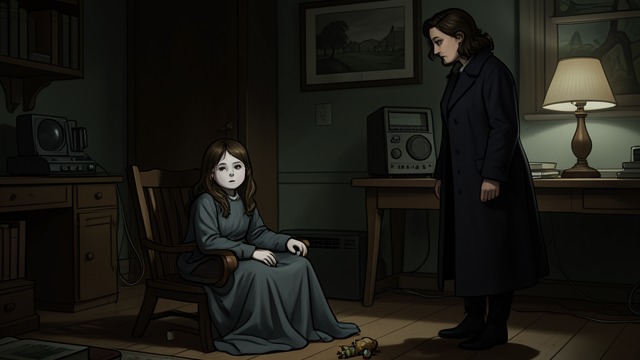
Watching Is a Choice
Adult spectatorship
Linnea’s drawings and later testimony suggest that adults around her saw fragments of what was happening yet failed to protect her. Annette Lundström repeatedly looks away, while other adults place family reputation, authority, or convenience ahead of the child’s account.
Madeleine’s childhood likewise unfolds among adults who permit abuse and treat her distress as a problem to suppress. The repeated presence of observers turns silence into more than passivity: it preserves the conditions in which exploitation can continue.
The weight of complicity
The story’s ethical question is not limited to the direct perpetrator. It asks what responsibility belongs to people who benefit from a system, protect its members, or refuse to recognize a victim’s distress.
That question reaches beyond private families into schools, police work, and legal institutions. The book gives no simple measure of complicity, but insists that omission has consequences and that calling a child unreliable can become a way of choosing the adult’s side.
A Different Ending to the Chain
Choosing Not to Continue
Revenge’s promised solution
Madeleine’s life has been organized around retaliating against the adults who exploited or abandoned her. She kills people she associates with that history, expecting each act to resolve the injury and restore some control over her life.
The deaths do not deliver the liberation she imagines. After confronting Charlotte Silfverberg, Madeleine recognizes that revenge cannot recreate the childhood or relationship she was denied, and that one more killing will not make the past become different.
A break, not a reconciliation
When Madeleine meets Victoria, she has the opportunity to extend the chain of violence to her biological mother. Instead she lowers the weapon and leaves Victoria alive. The choice does not repair their history or create an instant bond, but it interrupts the expectation that injury must be repaid with injury.
Her restraint is a real change precisely because it does not come with forgiveness, certainty, or emotional relief. The novel offers it as a difficult refusal to repeat the pattern—not as proof that trauma has been overcome or that the consequences are finished.
Victoria’s childhood, before her family’s move to Sierra Leone
Summer 1986, at the fair and the Fyris River
Decades later, during the murders of the exploited boys
From the childhood abuse of Linnea and Madeleine through their later crises
Late in the story, as Madeleine confronts Victoria
